

How does a Rotary Die - slitting Machine work?
Sep 08, 2025
Leave a message
A rotary die-slitting machine is a highly specialized piece of equipment widely used in various industries for precise cutting and slitting of materials. As a leading supplier of Rotary Die-slitting Machine, I am excited to share with you how this remarkable machine operates, its key components, and its applications.
1. Introduction to Rotary Die - slitting Machines
Rotary die-slitting machines are designed to cut and slit materials such as paper, cardboard, plastics, textiles, and metals with high precision and efficiency. They are commonly used in packaging, printing, label manufacturing, and other industries where accurate cutting of materials is essential. The main advantage of rotary die-slitting machines is their ability to perform continuous cutting operations at high speeds, making them ideal for large - scale production.
2. Key Components of a Rotary Die - slitting Machine
2.1. Unwinding Unit
The unwinding unit is the starting point of the process. It holds the large roll of the material to be processed. This unit is equipped with a tension control system that ensures a constant and proper tension of the material as it is fed into the machine. Maintaining the correct tension is crucial because it prevents the material from wrinkling or stretching, which could lead to inaccurate cutting.
2.2. Feeding System
The feeding system is responsible for moving the material from the unwinding unit to the cutting section. It typically consists of a series of rollers and belts that grip the material and transport it at a consistent speed. Some advanced feeding systems can also adjust the feeding speed based on the requirements of the cutting process.
2.3. Rotary Die - cutting Unit
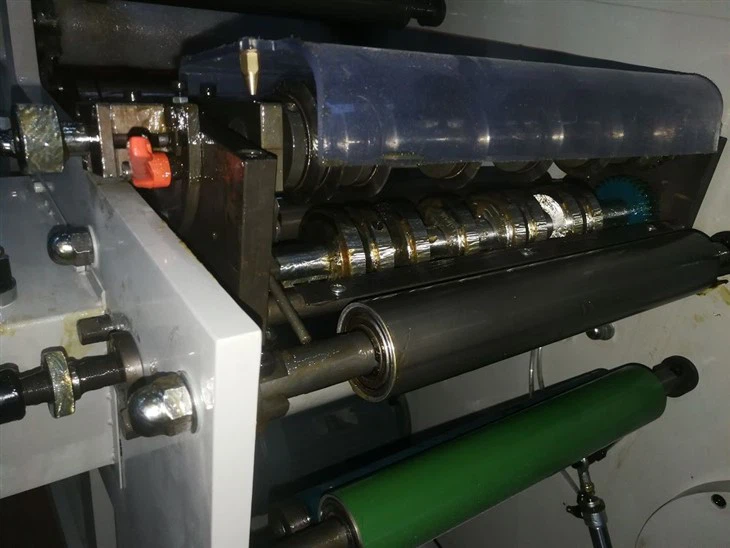
The rotary die - cutting unit is the heart of the machine. It consists of a rotating die cylinder and an anvil cylinder. The die cylinder has a cutting blade or pattern engraved on its surface, which is designed to cut the material into the desired shape. As the material passes between the die cylinder and the anvil cylinder, the cutting blade applies pressure to the material, cutting it precisely.
There are different types of rotary die - cutting units. For example, Semi - rotary Die Cutting Machine is a type that offers a balance between cost - effectiveness and cutting precision. It is suitable for applications where high - speed cutting is not the primary requirement. On the other hand, High Speed Rotary Die - slitting Machine is designed for large - scale production with extremely high cutting speeds.
2.4. Slitting Unit
After the material has been die - cut, the slitting unit comes into play. It is used to slit the material into narrower strips or sections. The slitting unit typically consists of circular blades that are adjusted to the desired width of the strips. These blades can be made of different materials, such as carbide or high - speed steel, depending on the type of material being slit.
2.5. Rewinding Unit
The rewinding unit is the final stage of the process. It takes the cut and slit material and rewinds it onto smaller rolls. Similar to the unwinding unit, the rewinding unit also has a tension control system to ensure that the material is wound evenly and tightly. This results in neatly packaged rolls that are ready for further processing or distribution.
3. The Working Process of a Rotary Die - slitting Machine
3.1. Material Loading
The operator first loads the large roll of the material onto the unwinding unit. The material is then threaded through the feeding system, making sure it is properly aligned and under the correct tension.
3.2. Setup and Calibration
Before starting the cutting process, the machine needs to be set up and calibrated. This includes adjusting the position of the die cylinder, setting the cutting pressure, and configuring the feeding and cutting speeds. The operator also needs to ensure that the slitting blades are correctly positioned and adjusted to the desired width.
3.3. Cutting Process
Once the setup is complete, the machine is started. The material is fed through the feeding system at a constant speed. As it reaches the rotary die - cutting unit, the rotating die cylinder cuts the material into the desired shape. The cutting process is continuous, and the machine can produce a large number of cut pieces in a short period.
3.4. Slitting Process
After the die - cutting, the material moves to the slitting unit. The circular blades in the slitting unit slit the material into the required widths. This step is important for applications where the final product needs to be in a specific width, such as in label manufacturing.
3.5. Rewinding
Finally, the cut and slit material is rewound onto smaller rolls by the rewinding unit. The finished rolls are then removed from the machine, and the process can be repeated for the next roll of material.
4. Applications of Rotary Die - slitting Machines
4.1. Packaging Industry
In the packaging industry, rotary die - slitting machines are used to cut and slit cardboard, paperboard, and plastic films into various shapes and sizes for packaging boxes, labels, and sleeves. They can produce precise cuts, which are essential for creating high - quality packaging products.
4.2. Printing Industry
The printing industry uses these machines to cut printed materials, such as brochures, flyers, and magazines. The ability to cut materials accurately ensures that the final printed products have a professional and neat appearance.
4.3. Label Manufacturing
Label manufacturers rely on rotary die - slitting machines to cut labels from large rolls of label stock. These machines can cut labels of different shapes and sizes with high precision, which is crucial for the proper functioning and aesthetics of the labels.
4.4. Textile Industry
In the textile industry, rotary die - slitting machines are used to cut fabrics into different shapes for clothing, home textiles, and other textile products. They can handle a variety of fabrics, including natural and synthetic fibers.
5. Advantages of Our Rotary Die - slitting Machines
As a supplier of rotary die - slitting machines, we offer several advantages. Our machines are built with high - quality materials and advanced technology, ensuring long - term reliability and durability. They are also designed with user - friendly interfaces, making them easy to operate and maintain.
In addition, our machines can be customized to meet the specific requirements of different industries. Whether you need a machine for cutting delicate paper or tough plastic materials, we can provide a solution that suits your needs.

6. Contact Us for Purchase and Negotiation
If you are interested in our Rotary Die - slitting Machine or have any questions about its operation, applications, or customization options, please feel free to contact us. We are always ready to provide you with detailed information and support to help you make the right decision for your business.
References
- Packaging Machinery Handbook, Second Edition. Edited by Wilmer A. Hall.
- Printing Technology: Principles and Practices. By Paul F. Hornsby.
- Textile Manufacturing Handbook. Edited by Subhash Anand.